All posts by swanstuff

Writer, small business wannabe, pundit, philosopher, often hopelessly confused, and blessed by a gracious God beyond all imagining (the views expressed by this blogger do not necessarily reflect the Supreme Being, but this blogger hopes he doesn't embarrass the Big Guy too much).

Outline to Structure Greatness

Story structure is as old as Aristophanes. It maps to expectations in the reader’s brain. The structure map must correspond to your story scenes. If it doesn’t (and don’t worry, there are millions of ways for it to do so), it will be boring, confusing, and incomplete.

See the source image
This is NOT the kind of outline we’re talking about.

The map is straight forward:

World-building – Where are we?

Status Quo – What’s normal life for the hero? Is it comfortable, tolerable, wonderful?

The Problem – Something challenges normal.

The Inciting Incident – Something makes normal no longer possible and the problem MUST be solved.

Initial Commitment – The main character commits tentatively.

Commitment Tested – That commitment is tested.

Point of No Return – ONLY the main character can solve the problem, fully committed.

Challenge of Character-Plan-Relationships-Self – Put the main character through every ringer possible

Wins and Losses – Sometimes he wins, sometimes he loses; always character is challenged.

Raising the Stakes/Rising Tension – The deeper in, the more dangerous it gets, often in a giant leap. This isn’t restricted to action plots; emotional risk is equally compelling.

Gaining Power – Through all trials and travails, your main character is growing and getting equipped to take on the final challenge.

Reversal – Expectations are confounded, twisted, reversed.

Discovery – The solution presents itself, often only in the character’s mind, not in the words themselves.

Climax – This is it, the final solution played out, the opposition defeated.

New Normal – What’s life look like now? This is the completion of the character arc.

A word about outlines. You can certainly begin with an outline, but expect it to change. If you are an outliner, update your outline as you go. If you’re not, make one after the first draft. Each scene should slot into one of the above structure points. While it’s tempting to say they should always fall in this order, and more or less do in traditional stories, you can climb out of the box, or, like Tarantino, set the box on fire and stomp it out. Nonetheless, each of the elements above are in his stories, just taken out of order.

You might see structures detailed with different words, or some of them combined, but they are all essentially the same.

What happens if a scene doesn’t fall neatly into one of the elements? First, ask yourself if you’re sure it doesn’t fit. If it truly doesn’t fit, ask yourself, “is it necessary?” Can you cut it? Have you by some miracle discovered a new structure element?

Your cutting guide is simple: If I cut it, does the story improve? If I don’t, is it harmed? “Elementless” scenes may be funny, and you can get away with them if they don’t drag down the pace. Is there conflict? Every scene should have some form of conflict. If it doesn’t and it can be cut, cut it. It’s that simple. And that hard.

Why SO Series?

There’s no denying that book series make more money for an author. If someone reads one and like it, they may buy all of them. It also works the other way. W.E.B. Griffin was one of my dad’s favorite writers, but I knew if I started reading a series, I’d have to read them all and he wrote 160 books. When I retire. Really.

Still, I’m weird that way, so financially, writing series does make sense.

But I’m weird in another way. Once I’ve written a book about a set of characters, I’m done with them. It would be easy to turn Do Angels Still Fall into a series; and Me and the Maniac has several internal series with characters I really love… but I’m ready to move on to new characters. Yet I love series. Spencer for Hire, Jesse Stone, and as a kid, Homer Price, Encyclopedia Brown, and a dozen others.

I think it’s a special kind of writer who can write a series, and I don’t mean financially motivated. They are more interested in the story of their characters than just story. They ask, “What are they doing now?” They aren’t finished with their characters. They BEGIN with characters. I begin with a story idea. I like to think they are all in a shared universe, that Bungy may run into Hud, but their stories are separate.

See the source image
Series can be lucrative…

Neither approach is wrong. If you’re inclined to write a series, make sure:

  • The story is your character’s story; you’re not shoehorning your character into someone else’s story.
  • It isn’t just a retread of the last story. Same genre, yes, but not same storyline or story arc.
  • The role of your characters is either the same or logical. For example, if in one book Character A is the lead role, and in the next book, a side character is the lead role and A is a side character, you must ask why she lost the lead?
  • Your characters are interesting enough to carry a series.
  • Your characters can change, but not so much that there’s no new arc to explore.
  • Your motive isn’t purely financial. You really have to love your characters. I love my characters, but not in a way that I want to document their continuing lives (though one never knows the future).
  • You don’t fall into the same ending time after time. In a military lawyer series I read, three times in a row the author made the bad guy the lawyer’s new girlfriend.  Great books that let you down in the end….
  • Include humor. I could be wrong, but most series I read have a healthy dose of humor, even the serious ones.

My advice, write a series if you have to, if you’re compelled to. If you must know what your characters are doing now, maybe your readers do too.

Never write a series for the sake of writing a series. Good stuff never happens that way.

What are your thoughts on series? What do you see as the pros and cons?

Why Do We Read?

This blog is all about writing, but it’s natural to therefore look at reading.

I love it. If you read this blog, you love it. But why should we do it?

See the source image
This kid has a bright future!

  1. It’s a great way to learn! I’m known as a keeper of arcane trivia, and not so arcane. I only showed up for tests in my college Astronomy 101 class. Everything I needed to know about astronomy I learned in comic books. Non-fiction is all about learning. Beware, though; be discerning; you can learn right and you can be seduced by the dark side.
  2. It sharpens critical thinking. Or it can. Most stories flow logically and offer a logical twist or two. Keeping track of a story sharpens your thinking. Sorting through red herrings and real clues makes you discriminate.
  3.  It widens your world. Trapped in a small suburb, I traveled to the stars, the past, far flung places without ever leaving my couch.
  4. You can try on different occupations. You find out what it is to be a lawyer, a crook, a conman, a detective, a superhero, and a thousand other occupations. Me, I found writing, but I was intrigued by lawyers (talked out of it by my Uncle Lawyer, darn it).
  5. It increases your imagination. This is the elephant in the room, not because it’s hiding but because it’s big! Life is made interesting with an imagination and like anything, it takes exercise to strengthen. Bench press a book! Workout your dreams!

You’ll benefit by reading, a realm of pure imagination. You make the sets, you envision the characters, you direct the action!

I recommend reading widely. By the time I was 14 I’d read thousands of books from dozens of genres. Thousands of comic books, hundreds of non-fiction books, thousands of magazines. I’d read the Bible, the Koran, the Upanishads, Sun Tzu, even the Peal of Wisdom. I was, unfortunately, stuck reading English, yet loved the plays of the Greeks and even the French. German plays were weird, even in the translations. I can’t help but know things.

I don’t read quite as much as I used to. Barely 24 – 30 novels a year, just a smattering of non-fiction. I admit I love comics, but no way I’ll spend that kind of money of them (thank goodness for libraries). My Kindle has hundreds of books I have yet to read.

And I still live a full life.

Read. It’s good for you. And for authors.

An Idea Shared is an Idea Improved

A few years ago, I decided to make Prevail Press a different kind of publisher. I was excited to be able to provide the kind of help I was looking for myself as an author. Typically, I would embark on such a venture on my own, but this time I was prompted to try a different path.

Integrity had to be the watchword, so I gathered several people;

  • Tom and Debi Walter: Tom is a successful businessman, and he and Debi run a marriage improvement ministry.
  • Bob and Bonnie Anderson: An engineer and humor blogger, as well as an author shopping a book around to traditional publishers and agents.
  • Bill and Colleen Hufford: A retired businessman and both are civic-minded.

I laid out my plan; open Prevail Press to authors traditional publishers let down. To become a new kind of publisher that is neither traditional, vanity, or self-publishing, but had aspects of each.

Then I asked them to be my Board of Directors. While I am confident of my integrity, I knew having independent parties with whom I would be accountable and transparent could only help. I looked to them for equal parts integrity, encouragement, and business sense. Color me thrilled when they agreed even though it didn’t include compensation.

We’ve met several times, and wonderful ideas came out of each meeting. And so, Prevail Press began and a few authors with great books found us. Yet I did encounter problems.

Social Media is hard on start-ups. My Facebook posts describing Prevail Press were re-colored as just another vanity press. Not true on several counts. Vanity Press accepts any book, we do not. VP makes their money on authors, we do not. VP depends on order-minimums, we do not. It became discouraging, I’ll admit it.

I’m not a big fan of getting email spam, so I don’t want to create an email list (eventually, when we have enough authors to call for regular, fresh content, we’ll revisit that decision). Promotion is mostly networking authors who help each other promote; the more authors, the wider the reach. Tom suggested a weekly blog, which you’re reading right now.

We met again last Sunday. I had some new promotion ideas (you’ll see them soon) and shared some issues. It was for the sake of transparency, but when they all began piping in, “I can handle that.” “Give me that issue,” “I have that one…”  I am not an emotional guy, and I think I hid it well, but tears burned my eyes. There is such STRENGTH in groups! They cared enough to lift things off my shoulders!

We also spitballed a new operating model, making a good deal even better.

Writers who contact us will get a FREE evaluation of their manuscript. No reader’s fee, just personal feedback about what works and what doesn’t. My evaluation team will access the suitability of your book for Prevail Press. Even if not selected, you’ll get feedback for improvement or affirmation of quality.

If we all agree you’re a match for Prevail Press, we’ll move forward. For the low price of $100, you’ll get:

See the source image
Never go it alone!

  • An ISBN for each version of your book, print and Kindle.
  • An Author’s Page on Prevail Press
  • A professional book design
  • A round of editing
  • A single book cover design
  • If greater editing or a different cover design is necessary or desired, an introduction to partner professionals who offer reasonable rates.
  • All publishing details handled
  • An introduction to the other Prevail Press authors
  • Consultation on building a platform

That’s a $2000+ value for just $100. Why? Because no one should go it alone. To really serve authors struggling to find a publisher, cost must be low.

Thereafter, author keeps 90% of royalties, Prevail Press a mere 10%.  Traditional publishers reverse that ratio.

Some authors are diehard self-publishers. That’s fine and more power to them. If you’re not well-versed in self-publishing, if you don’t want to go it alone, go to www.prevailpress.com and click Submission Guidelines.

Let’s take this adventure together!

Valentine’s Day is Hard

They say Valentine’s Day can be painful for single people. Let me tell you something from 29 years of marriage… It can be difficult for married people as well.

Don’t get me wrong, I love my wife, more today than yesterday and that’s been true every day since we met. Today is deeper and wider than it is fiery and cha-cha.

We’re both romantically impaired. There I said it. To us a lighted candle means it’s too dark to read. Fortunately, we have electric lights and a book that serves as a great inspiration. That book is…. drum-roll, please…

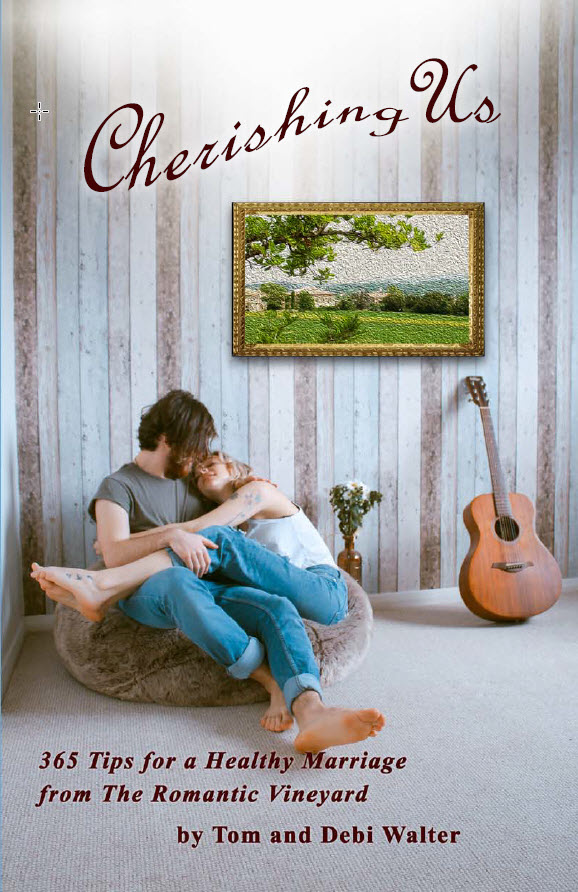
Cherishing Us! by Tom and Debi Walter, the people who put the romance in romantic.

See the book, buy the book

Young love, old love, any love…

This book is full of challenges… I mean “tips”… one for each day, that ignite your days AND nights…

Another book that helps is 7 Essentials to Grow Your Marriage by Steve and Cindy Wright. They lay down the fundamentals of relationship from a he-said/she-said perspective. Getting the masculine AND feminine side of each essential provides a balance other marriage books lack.

See the book, buy the book.

It can fix what ails ya.

There’s still time to buy them for Valentine’s Day. Guys, I assure you, your wife LOVES it when you invest in your marriage!