All posts by swanstuff

Writer, small business wannabe, pundit, philosopher, often hopelessly confused, and blessed by a gracious God beyond all imagining (the views expressed by this blogger do not necessarily reflect the Supreme Being, but this blogger hopes he doesn't embarrass the Big Guy too much).

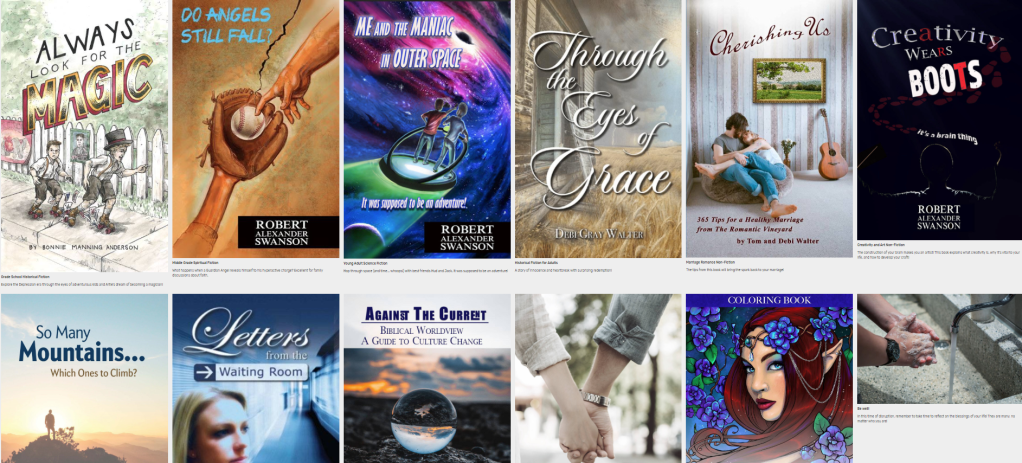
Reader’s Delight!

I am regularly humbled by the authors we publish. Their generosity and willingness to go the extra mile for their readers is amazing.

Nowhere is that more evident than this week’s sale on all Kindle editions of Prevail Press books. It wasn’t my idea, it was the authors who suggested we offer our readers a Pandemic Discount. We know that our responsible readers are practicing social distancing and may have extra time on their hands. What better use of that time than reading?

This week, all Kindle Editions are 99 cents each. That’s a $3 savings! Buy all for $9 and save $28! I guarantee, you’ll find delights for your whole family!

Our authors are all heart!

Go to this link: http://www.prevailpress.com/page17.html and click the book covers of your choice to take advantage of this offer. While some books don’t have Kindle versions, all physical books are available at their regular price.

There is something for everyone: Fiction for all ages, non-fiction that will illuminate and delight you, and especially now in this time of close confinement, a marriage book with daily tips for romance to make those days together sizzle!

Such a Time As This: 5 Steps to Demolishing Writer’s Block.

The greatest form of Writer’s Block is lack of time (it’s really lack of scheduling time, but for now, let’s just call it time).

Well, now you do!

Sledge Hammer Smashing A Concrete Block Stock Video - Download ...
Break that Block!

I’m not suggesting you abuse your Work from Home status if you are working from home for your day job, but there’s commute time-savings that can now be devoted to writing that book you’ve been meaning to write.

I know, I know, the first week or two was all about binge watching TV, but that gets old fast. There’s only so much yardwork. Grab that laptop and get comfy. Here are a few tips for getting started.

  1. You don’t have to begin at the beginning. Eventually you’ll have to write that, but that scene that’s been clawing at your mind? Write that. If you’re afraid of writing a book, don’t, just write chapters. You can assemble them all later. That’s the Post-It Note method of writing. You write all the juicy stuff, then fill in what’s needed. (I’m going to plug Scrivener again, because it’s GREAT for this method).
  2. Get to know your character. If the character is single, how would they write his or her dating profile for an online link-up site? You don’t have to include that in the book, it may be something your character would never do… that’s OK because it’s just about getting to know how your characters thinks about themselves. Alternatively, you can create their LinkedIn profile or any other kind of profile the characters would write about themselves.
  3. Write Your Character’s Eulogy. It’s said that there are two ways people think about you, the expedient way for day to day interaction—which can be harsh, truthful, and oh-so-private—and their cleaned-up way. This is the kind of thing that would be shared as a Eulogy, which has its own kind of truth. In the first way, they look at the worst, in the second, the best. Your story will display the expedient way. This eulogy is the subtext of how one character views another. For example, I had a college friend who was selfish, deceitful, and opportunistic. He was also knowledgeable, talented, and fun to be around. We operated out of both, but the negative was close to mind for survival, yet the positive influenced everything we did.
  4. Write the Travel Article. Where do your characters live? What is the setting? How would each character write a travel article? Some would be disparaging, others lyrical, others selling the place. How characters think about their setting is important.
  5. Figure out your best entry point and exploit it. I love beginnings. That’s where I start. However, if I think in terms of Acts, a story has at least three beginnings, one for each act. When I get stuck, I can write the beginning of Act Two or Act Three. That would give me tentpoles from which to swing, so filling in the story is easy. My son likes to write action, those are his tentpoles. What are yours?

We may be staying home for a while. We can see that as a negative, or we can see it as a positive.

How do YOU get started?

Today’s World IS Sci-Fi!

For years I resisted getting a cellphone. Back then they were dumb flip-phones, very rudimentary. Today, my hand-held supercomputer occupies way too much of my time, just ask my wife.

Cellphones are great for connecting to the world, but that’s a sizable problem for fiction writers. One of the jobs of storytelling is to isolate your main character and the situation. After all, if they aren’t isolated, they can solve the problem with a simple phone call to someone more capable. Stakes are lowered, tension is dropped, main character motivation is compromised.

Image result for guy in a box
You gotta be IN the box to think OUT of the box!

Twenty years ago, isolating a character was easy. Cut them off on an island, maroon them out of their depth, have the car break down. Now help is a cellphone call away. Out of power? Borrow someone else’s, everyone has one.

Need to defuse a bomb? YouTube has your back and it’s right on your phone.

You can break their phone, have them forget their phone, be beyond cell service… but that only works for so long.

Historical fiction is looking very good these days.

Good writers can find a way, of course. In thrillers and suspense stories, you can be tracked with your phone, so depower and remove the battery. Or perhaps your character is a technophobe or allergic to electronic frequencies (supposedly a real thing).

No matter how you do it, you have to be believable and consistent in isolating your characters. If the reader has to ask, “Why didn’t she just…” then you’ve pulled them out of the story.

What are some ways you’ve isolated your characters?

In Light of the VIrus

You’re a writer with a writer’s mind. Probably, like me, you’re using the Coronavirus as at least a mental writing prompt.

Oh, my head has spun conspiracy stories, dystopia stories, pathogenic stories, and more.

Image result for genius
Beware the Writer’s Power!

World events are grist for the mill. Let me encourage you with a few thoughts:

  • Write them down! Always good to have a number of project ideas.
  • Do NOT share them! Really. Right now, some people are sanguine, some are nervous, some scared, some annoyed, and some on the very edge of panic. The problem is, you don’t know who is who. Your clever story ideas could spin them into weird mindplaces.
  • Don’t mistake them for reality! Right now, we’re all a bit isolated. Sure there’s stuff going on. Sure, there may be more than we know about. Chances are, you haven’t come up with anything beyond fiction. Just as it isn’t wise to freak out other people, don’t freak out yourself.

As writers, we’re a bit weird. That’s OK. We can be the life of the party! But use your powers wisely. With great imagination comes great responsibility.

As in any crisis, no matter how you feel about it, strive to think of what you can do for your fellow person. After all, they are your audience; take care of them!

But please, please, please, remove “Stay Safe” from your vocabulary. It’s inane, tone-deaf, and while well meaning, is hollow. “Take care of yourself,” “be well” “See you later” all good cliches.

Be well!

Who’s S.E. Hinton?

I recently said “Stay gold, Ponyboy” to a gentleman my age who had been an English major. He looked at me like I was crazy.

“Ponyboy. The Outsiders? S.E. Hinton?” I said.

“Who?”

Color me stunned. The Outsiders is the best-selling YA book of all time, and some say first, that came out when I (and he) were kids. It was required reading in High School. It was a MOVIE for goodness sake!

“Who?”

I sent him the link on Amazon and like a true nerd (I say with awe and wonder), he bought it. 😊

The Outsiders was also one of the most banned books in schools, right up there with Catcher in the Rye.

See the source image
There are dozens of book covers, but this is the first I remember.

Susan Hinton began writing it when she was 15, completed it at 17, and was published at 19. It’s about rival gangs, includes violence, budding sexuality, and other true-to-teen life stuff. It’s very sad, very, very sad. And while I didn’t like Catcher in the Rye, it’s in that ilk and I enjoyed The Outsiders.

Her publisher recommended going with her initials so her gender wouldn’t hurt sales. She kept using H. E. with Rumblefish and That Was Then, This is Now, and her later books for adults.

It was published in 1967, written in Oklahoma and you can tell. It’s a powerful story largely because it’s written truthfully from a kid’s point of view.

I suspect it was so well received because, let’s face it, teenagers like to read about people worse off than they are.

Susan Hinton became “relevant” again recently when a Twitter comment asked if two of her characters were gay. She responded that no, they weren’t, her characters are straight because she is and can’t write truthfully from a gay perspective. The Internet blew up at her for that. She probably sold a lot of books as a result of the exposure. No publicity is bad publicity, after all.

Let me be up-front, I dislike the term “My Truth” since truth is truth and everything else is perspective, BUT, from a literary perspective, what is your truth—the thing you can write about from the inside? Hinton’s books work for teenagers because it rings true in ways other books, even better-written books, don’t.

Susan Hinton looked around herself in High School and asked what it would be like to see the world from one of the “greaser’s” eyes. Eight million copies sold later, she continues to do so. Whose eyes can you honestly look through?