Beta Readers – Your Best Frenemies

You’ve finished your book, congratulations! Or have you?

Have you put your manuscript through Grammarly? Then through an editor? Ah, you have! Good for you!

You’re still not done, though. Now you need to let your beta readers at it.

See the source image
Beta’s: Feisty but Necessary

What are beta readers? They are NOT editors. Editors are trained in story, grammar, and (gasp!) spelling. Your beta reader, or first reader, is just as valuable because they aren’t trained. They are ideally regular readers, which means they have an intuitive grasp of story, which can tell you more than an editor can.

Beta readers are not paid. Let’s get that out of the way up front. These should be readers who are friends or acquaintances. They should love your genre. Here is what they should NOT be:

  • Editors (or if they are, make sure you have several who are not).
  • Afraid to hurt your feelings.
  • Too busy to read your book (that’s one reason why you give it to several beta readers, because life gets in the way of even well-meaning readers).
  • Outside your genre audience. A mystery reader may not be aware of sci-fi conventions.
  • They probably shouldn’t know what “conventions” means.

Your purpose in handing your pre-published book to beta readers is to find the parts that don’t work for a reader.

  • What areas are slow?
  • What areas lack enough information?
  • What rings false?
  • What doesn’t feel consistent for a given character?
  • Is it a quick read or do you have to slog through it?
  • Is the ending satisfying?
  • How would they describe your characters? Do they mesh with what you’re trying for?

William Goldman, a fabulous writer, has a single aphorism: “Nobody knows what works.”

Your beta readers are the ones who can tell you if it does. Or doesn’t. And if it doesn’t, you need to fix it.

Movie executives know the power of beta readers, or pre-screenings in their medium. They’ll run a movie across a crowd of non-paying people and then poll them, question them, and milk them of every scrap of useful information. If anything doesn’t work, they’ll change it. It may cost millions to change, but they change it.

If they’ll pay anything, you can put in the hours to correct areas of issue.

Let the beta readers know in general what you want to know. Is the story satisfying? Where isn’t it? What works, what doesn’t? Which characters do you like (why?) and hate (why?).

Then assure them they can tell you anything and it won’t hurt it will help (it’s okay to lie to beta readers. It will hurt, but it WILL help).
Amazon is Great… Except When it’s Not

Amazon changed publishing, making it easier for writers to get their work out there… and thereby harder to find, and quality uncertain. Still, great for writers with fantastic books who can’t find traditional publishers.

Their tools are handy, their customer service is spot-on, if a bit slow. I really have few complaints, but a bit of trepidation. About what?

Image result for amazon smile
It’s kind of an evil smirk, isn’t it?

Amazon Ads.

If you have a Kindle of any kind that you bought at a discount, it’s going to have ads. Sometimes as a little panel at the bottom, other times as the screensaver, and under your Books home page.

On Amazon, ads are listed at the beginning of a search, or in correlation with other books of a similar topic, these ads are pay-for-click. If they sit there and no one clicks on them, you don’t pay. If they do, you pay a certain amount that you set to begin with. For example, you may set a limit of $50 at $0.25 per click. That’s 200 clicks. In traditional advertising, a 3% closing rate is expected. That’s 6 sales of your book. You’ve spent $50 to make $12-15.  Ah!  But those who bid 50 cents-a-click get higher ranking! Perhaps 3% is low. I’m going to give it a try with my book, “Creativity Wears Boots.”

A suggestion: Do not do the Kindle ads. Have you ever clicked one?  Stick to the related products ads.

You can also get higher ranking by being a best-seller in your category. I am thrilled to admit that I am a best-seller now. My book “Creativity Wears Boots” has been on sale with no promotion yet (I’m working hard on getting two other books ready for publication. Success on the first: Faces & Fantasy by Dawn Davidson. An adult coloring book… wait, a coloring book for adults! Or kids. It’s really amazing art work, and anyone who likes to color with pencils, markers, crayons, watercolor… oh are you going to be excited. Watch this space.

The second is in the editing phase. More about that one later.

Once I catch my breath, I’ll promote my own book, but it’s really fun to see people stumble across and and buy it without promotion. My efforts will always be on my authors, but I’ll squeak my own campaign in there soon.

But this is about Amazon.

Amazon is trying. They can’t select for quality, I get that, so those willing to spend to get attention get ranking, so ranking doesn’t necessarily equal quality.

For quality, pick a publisher (like Prevail Press) who only offers quality books. Such publishers are gatekeepers of quality. Make note of books that are poor and don’t buy from their publisher, which is likely a vanity press, who publishes anything, or a well-meaning self-publisher.

Consider joining us at the double-P (hmmm, gotta try a better nickname). We help each other and provide a voice in the wilderness!

Procrastination – it’s making me wait

In a TED talk, Mathew Blanchfield makes the claim that original, creative thinkers are procrastinators. And worriers. And self-doubters.

If he’s right, I’m golden.

See the source image
Tomorrow… or the next day

He also said creative people have a lot of bad ideas, but because they procrastinate, the best ideas rise to the top.

I have a friend who picks on me about how long it takes me to write a book, and that all those half-written novels aren’t really stories I care about. I take the ribbing in stride though, because I’ll often have a story idea I’m not ready to write yet or at least not fully. Because I take so long, often requiring some event or inspiration to spur me on, the story is better. If I wrote it in a rush, it wouldn’t be the same story and I suspect not as good.

That doesn’t mean if you’re the blurt-and-finish type that you’re doing it wrong. We each have our method that serves us.

I’ve imagined my method is about stoking and exhausting the fire, then recovering and stoking it again. If I were a runner, which I’m not, I’m sure I’d run for a while, then walk for a while, then jog, then amble. That’s who I am. I like to sleep on things, and I don’t start until I have a grasp of how to handle it.

Inspired by my Colorado trip, I wrote the prologue of a new novel, and while I know what has to happen to introduce my main character, the specifics aren’t there yet. I could force it. Bribe it. Take a wild stab. Or, I can wait for it. As a generally busy person, that’s easy to do.

I do vary from Matt’s description. When I write something, I don’t doubt myself. That comes before, not after. It’s a failing, because I should be more open to rewriting (which I do, but it isn’t easy for me).

What about you? Does this describe you? I assume if you’re reading my blog that you’re creative. Give us a peak into your method, process, or way of accidently doing it.

Does the idea of procrastination as a hallmark of creativity resonate with you, or do you reject it?

Leave your comments below.

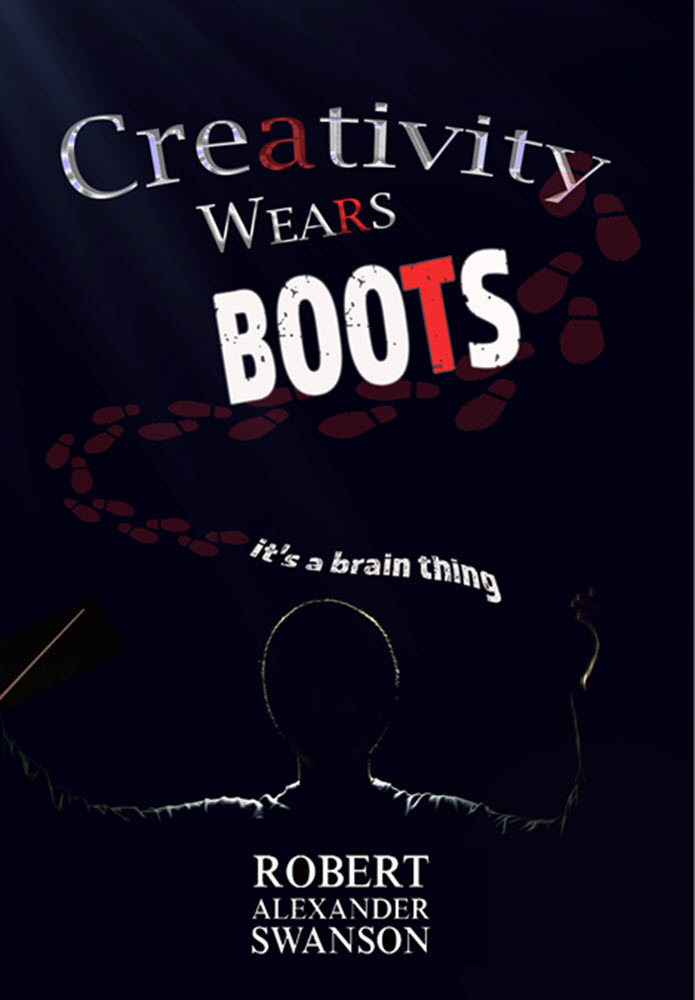
Creativity Wears Boots!

Rush to Amazon now! Prevail Press has published a new, exciting, and provocative book.

Creativity Wears Boots by Robert Alexander Swanson

Unlike any other book on art and creativity, Creativity Wears Boots tells you exactly what art and creativity are – pssst, it’s a Brain Thing and the BIRTHRIGHT OF ALL HUMAN BEINGS!

Seriously, to be human is to be an artist, our brain demands it! This book, priced attractively at $9.97 in paperback and $3.97 is Kindle format, walks you through:

  • Why art is vital to every human being,
  • The purpose of artistic compulsion,
  • Why YOU are an artist,
  • What is important to every artist, and
  • How to develop your art.

If you don’t believe you’re an artist, you need to read this.

If you’re a practicing artist, you need to read this.

If you’re an art teacher (any medium), you AND YOUR STUDENTS need to read this.

If you know someone, anyone, you need to buy this for them as a gift.

If you’ve ever read any book on creativity, The Artist’s Way, for example, you need to learn what that book left out.

Seriously, go buy it right now! Here’s the link.

Goldilocks and the Three Books

See the source image
Forget Porridge, Papa, We Have Meat!

After a just-right meal and before going to the just-right bed, Goldilocks thought it would be nice to have something to read, so off to the den she went. She found three books side by side. The first book made no sense, the second book was too heavy, and the third book was just right.

Goldilocks has hit upon the writer’s greatest issue. What’s too little and what’s too much when it comes to description? That’s never an easy answer.

Hemmingway was the master of sparse prose. He had very little description, but what he had was spot-on. Tolkien was a verbose writer, yet he has a devoted audience. Therefore, it isn’t in the quantity of text as much as in the quality of text. Papa Ernest had concrete settings; Old Troll wrote fantasy settings. Each followed a single unstated rule: The right amount of description is that which says the most with the least.

A common cry of young authors is that they must make the reader see what they, the author, sees.

That’s ridiculous, though. Look at any adaptation of fantasy novel to movie. Is that what the author saw? Consider the author of Mary Poppins, who despaired because screen Mary was nothing like book Mary. It would be news to her to discover no one’s Mary was her Mary.

My sister read the opening of a novel I was working on and described the hero as “shallow.”  I didn’t think he was shallow at all!

It’s the author’s job to give just enough description for the reader to build their own version of the literary world. It’s going to be different for everyone.

Do you need to tell us what pattern of the couch? Maybe, if it directly relates to the character’s state of being, but just as description? Maybe, if that’s the defining characteristic of the setting. If it’s just a detail of insignificance, don’t tell us.

Little Bear’s book wasn’t descriptive enough. Goldilocks didn’t know what was going on.

Papa Bear’s book was over-descriptive, which Goldilocks found heavy and exhausting.

Mama Bear’s book found the balance. She helped Goldilocks build a picture rather than try to specifically implant her picture of the setting and characters.

I would love to give a rule, like: If it has no significance, delete it. But that rule doesn’t account for flavor.

A few details beyond just the important gives a flavor of the setting. It sets a tone. Further, things your subconscious puts in a scene may have significance later in the scene. I know a fellow who writes a scene and films it, writes another and films that. The problem with not knowing the ending is that you can’t sprinkle foreshadowing in. I’ve found often what I thought was inconsequential ended up being useful later (and I don’t mean introducing a gun in a scene. If there’s a gun, it must be used, or get rid of it).

The only rule I can possible give is: Keep it fresh. If your old man is in the sea, you better give me a unique scent of the tide. “The sea smelled of fish and salt.” Bleh.  “The sea smelled of rabbis and popcorn.” That’s a unique image.

The mark of a great writer is the ability to find the balance. Just enough, but not too much. Or the bears might eat you.

A unique publisher who is Author-Centric and Reader-Sensitive